
![maxresdefault[1].jpg](https://static.wixstatic.com/media/cef8ab_8d4e0ddce355463e8edabd7c8937b6f6~mv2_d_2500_1406_s_2.jpg/v1/fill/w_124,h_70,al_c,q_80,usm_0.66_1.00_0.01,enc_avif,quality_auto/maxresdefault%5B1%5D.jpg)
Passenger rail plods ahead - then two steps back
Apr 4, 2017
4 min read
For all the hand wringing over cuts for Amtrak and passenger rail in the federal budget, projects and proposed projects to increase or extend passenger service seem to be moving forward.
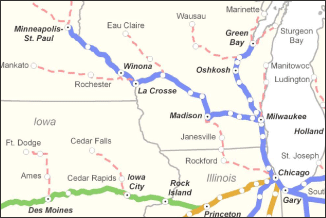
Take, for example, the Minnesota High Speed Rail Commission, which continues its push for a second daily schedule between Minneapolis and Chicago. Representing 17 governments, as reported in the LaCrosse Tribune, the commission sees a second train (the first is Amtrak’s Empire Builder) within three years, and doesn’t seem to be at all concerned that Amtrak’s long-distance trains may be in budget jeopardy.
Another example is the city of Eau Claire, Wisconsin, which has approved moving forward with plans for an Eau Claire—Twin Cities routing. Eau Claire is not currently on any Amtrak all-rail routing (there are buses), so this wouldn’t be an overlap with the Chicago—Twin Cities service, but it could be if cooperation between Minnesota, Wisconsin, and Illinois on the second train’s scheduled resulted in a routing through Eau Claire. On the other hand, that would leave a handful of municipalities out of the second route.

Whether wise or not, many other passenger projects seem to be moving ahead and taking the federal budget proposal as just another bump in the road. Some bump! If implemented, 220 cities and towns would lose Amtrak service. As I have pointed out before, there’s no private operator out there that’s positioned well enough to jump in and try to make a go of it.
***
Last week’s fire under an Interstate bridge in Atlanta, Georgia, underscores the need to have more than just incremental growth and preparedness in passenger rail. The fire, caused by an individual under the influence of drugs, resulted in the collapse or destabilization of six sections of bridge in both directions of travel. The repairs or complete replacements are going to take “several” months, per current reports; and the individual who set the fire will be prosecuted but will certainly bear none of the financial burden of replacement.

Atlanta’s metro area is served by MARTA, the Metropolitan Atlanta Rapid Transit Authority, which operates both buses and rail rapid transit. I can’t see how buses are going to help anyone impacted by the bridge crisis, unless new routes are created to get buses around gridlock. However, MARTA has four rail lines (really two with routing differences) that they hope will take up the slack. As of this writing, a twenty-five percent increase in ridership since the collapse has been reported.
But MARTA has spent more time in recent years with Transit Oriented Development than in gaining flexibility or increasing rail mileage. Granted, TOD will eventually bring more riders and the need for expansion of rail miles—incremental growth; but wouldn’t it be nice if there were already enough transit cars available to take every passenger that wants to ride instead of drive during the bridge reconstruction? I’m sure city fathers and MARTA executives will say they do, but MARTA does not seem to have any plans for this beyond further TODs and confidence that they have managed to handle “special events” in the past. To be fair, MARTA is positioned no differently than the vast majority of urban transit agencies.
***
Why is America’s transportation system in such a state? Why do we not have a vision of what a comprehensive, multi-mode systems should even look like in the next ten years? I think it’s power. I think it’s power and the quest for return to power, which drives every decision being made by Congress. When you’re hooked on power, getting people who can’t afford a limo or personal driver from point A to point B doesn’t seem very important.

As one unnamed senator put it, he has control over 1 percent of federal spending. This is a true statement if only on average, as there are 100 senators, 2 for each state. Think of it! One percent of last year’s federal budget was $39 billion. If you think about it another way, if we could convince every senator to devote just 1 percent of their part to transportation planning, that would also come to $39 billion.
On the other hand, by careful manipulation of that $39 billion under their control, politicians garner something far more valuable—permanent power. $39 billion buys a lot of permanency.

I’m starting to think that we’ll not find an answer until we find out how to divest transportation decisions from the budgetary process, such as it is. We won’t even be able to do that until the process of budgeting is returned to some sanity beyond the current spate of “continuing resolutions” that help Congress bypass deliberative decisions on federal spending.
Let’s hope and pray that things change soon.
©2017 – C. A. Turek – mistertrains@gmail.com
(Charles A. Turek is a writer and novelist based in Albuquerque, NM. After four decades working in areas of the insurance industry related to transportation, he now writes on all aspects of American railroading. Charles is a political conservative but believes in public funding of passenger rail as a part of the federal government’s constitutionally conservative obligation to provide for defense and public infrastructure so that private enterprise may flourish.)


Comments